
Product Information:
Name: Enchantment: The Art of Changing Hearts, Minds, and Actions
Page count: 224
Year of first printing: 2011
ISBN: 9781591843795
Although this book is not directly related to emergency medicine, but Enchantment: The Art of Changing Hearts, Minds, and Actions by management guru, Guy Kawasaki, has a lot to teach us, doctors in ER, on the one of the very important aspect of clinical medicine - art of persuasion and influence.
In it, Guy explains how to influence what people will do while maintaining the highest standards of ethics.
The book explains when and why enchantment is necessary and then the pillars of enchantment: likability, trustworthiness, and a great cause.
The next topics are really about the nuts and bolts of enchantment - the launching, overcoming resistance, making enchantment endure, and using technology. There are even special chapters dedicated to enchanting your employees and your boss.
The following infographic summarizes the main points of the book:
The following infographic summarizes the main points of the book:
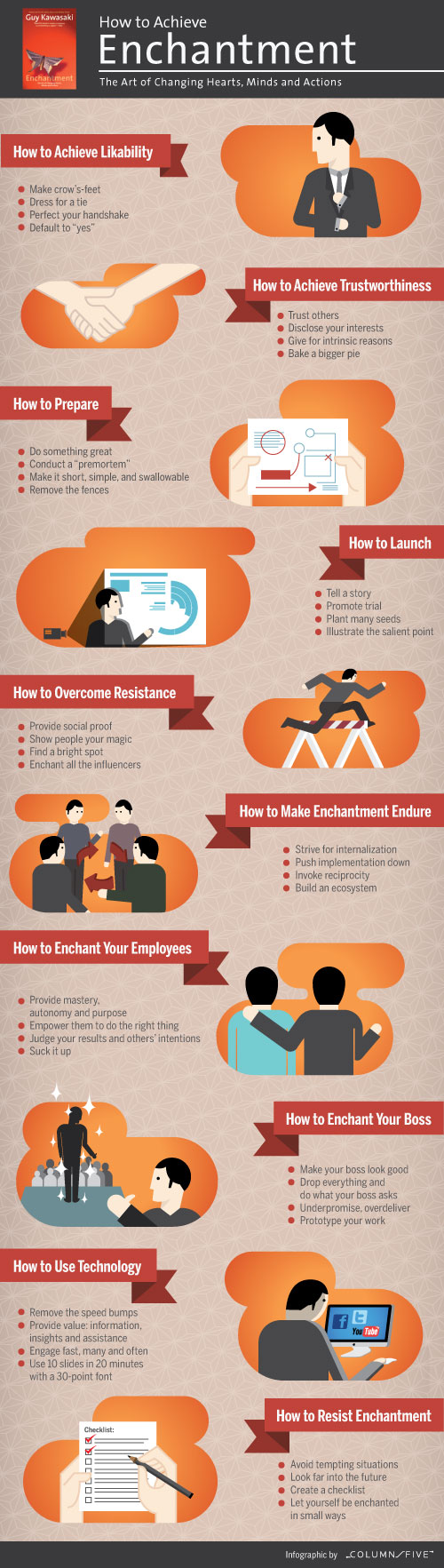
Overall, I find that this book is very intriguing. Lots of lessons to learn from (see below). It is written in an easy-to-understand, conversational style with ample illustrations including the various side real-life stories found at the end of each chapters.
I have personally learned a lot from this book.
I have personally learned a lot from this book.
On page 14-15, Guy talks about accepting others. For people to like you, they have to accept you. And for people to accept you, you have to first accept them. That simple. No rocket science behind the theory, although in actuality it can be much harder to do because:
- we tend to think of people in terms of binary, which fortunately, they are not. People are not binary, they are not either ones or zeros, smart or dumb, worthwhile or worthless. Everyone has strengths and weaknesses.
- we think we are better or superior to them. In reality, everyone is better than you at something. No one is superior to everyone in every way.
- we tend to think we are the most important people in the world, the universe revolve around us and our priorities deserve the kind of attention from people like the way we ourselves give. In actuality, people have their own concerns, their own stresses, heartaches, headaches, etc. As Guy said, "Don't judge people until you've walked a kilometer in their shoes. Give them a break instead."

Then, of course, there is this principle of K.I.S.S. (Guy's version: Short, Simple and Swallowable). The basic guidelines for brevity, depending on the techniques of communication, are:
- For email: six sentences (the six sentences are to answer the following questions: 1) Why are you contacting this person 2) Who are you? 3) What your cause is? 4) What you want? 5) Why the recipient should help you 6) What the next step is)
- For videos: sixty seconds
- For PowerPoint and Keynote: ten slides
- For business plans: Twenty pages
On page 66: regarding salient points. When illustrating salient points, translate the facts and figures into meaningful and comprehensible bite-size chunks of information. For example: when promoting ipods, rather than saying xx of gigabytes of storage capacity, speak in terms of the number of songs and movies that can be stored in that device. Other examples include: cars- say in terms of cost of fuel per year rather than miles per galloon; heater: heating expense in electricity bill per month rather than thermostat settings in degrees
Interestingly, on page 64, Guy quoted Iyengar and Lepper's findings that show that people are more likely to make a purchase when there are fewer choices available to them (you can download the original paper by Iyengar & Lepper here). More choices can also lead to ambiguity and dissatisfaction because people may look back and wonder if another option would have been better or more suitable for them. Bottom line, more choices available, more choices to regret. In other words, more is not necessarily always better.
On page 68: I like the idea of the importance of getting hold of a group (albeit small one) of first followers - zealous, enthusiastic followers, who will in turn, attract more followers. Read more about it from Derek Siver's article here.
The chapter on overcoming resistance to enchantment (pages 70-94) is particularly important and has a lot of similarities with what healt hcare professionals do to impart behavioral changes in patients. The initial section on the anatomy of resistance is particularly worth reading. There are five common reasons why people are reluctant to be enchanted (or to change):
On page 113 (chapter 8), Guy talks about leveraging the use of push technology. Some of the lessons I learned concerning engaging with people in communication using information technology include:
Being a Japanese-American, Guy also shared some Japanese Zen principles to increase our effectiveness on using technology for presentation (essentially this is based on the Zen aesthetic nature of the Japanese garden). Here are some I learned (more are mentioned in the book, page 149):
Of course, not to forget, his famous rule in power-point presentations: 10-20-30. 10 slides in 20 minutes with font size no smaller than 30 points. Although I find this rule to be effective, this is not always practical in my setting. It all depends on the purpose of your slide presentation. If you are doing it to engage with people, to sell a concept or product, then yes! the rule should apply. But in my case, I am using the slides for my lectures - educational purposes and for information dissemination. In such a case, 10 slides are definitely not enough, 20 minutes may or may not be enough depending on the topic of my lecture.
View the full-length lecture by Guy here:
You may also download the mp3 version of that talk here.
Original link. Click here
Interestingly, on page 64, Guy quoted Iyengar and Lepper's findings that show that people are more likely to make a purchase when there are fewer choices available to them (you can download the original paper by Iyengar & Lepper here). More choices can also lead to ambiguity and dissatisfaction because people may look back and wonder if another option would have been better or more suitable for them. Bottom line, more choices available, more choices to regret. In other words, more is not necessarily always better.
On page 68: I like the idea of the importance of getting hold of a group (albeit small one) of first followers - zealous, enthusiastic followers, who will in turn, attract more followers. Read more about it from Derek Siver's article here.
The chapter on overcoming resistance to enchantment (pages 70-94) is particularly important and has a lot of similarities with what healt hcare professionals do to impart behavioral changes in patients. The initial section on the anatomy of resistance is particularly worth reading. There are five common reasons why people are reluctant to be enchanted (or to change):
- Inertia. People at rest will remain at rest; and people in motion will remain moving in the same direction unless an outside enchanter acts upon them. Existing relationships, satisfaction with the status quo, lazyness, busyness etc
- Hesitation to reduce options. People like the ability to make choices and therefore, by making a decision, this gives them the perception of reduction of options, and the prospect of this outcome may scare them!
- Fear of making mistake. Related to the above point, people may think that as long as they have not made a choice, they have not made a mistake. Once they made a choice - they are either right or wrong. In reality, not making a choice - is a choice itself. (In the case of healthcare profession, this kind of ambivalence happens when patient is confronted with the option of whether to get a surgery/procedure or not)
- Lack of role models. That's why early adopters are so important, as Derek Sivers illustrated.
- Your cause suck! People are turned off by what you are offering. Then people are right and have the right to be reluctant.
On page 113 (chapter 8), Guy talks about leveraging the use of push technology. Some of the lessons I learned concerning engaging with people in communication using information technology include:
- engage fast - fast in today's digital age, means within 24 hours. All e-mail communications, for example, should be replied within 24 hours.
- engage many (or "sowing many seeds") - don't just focus on the rich, famous and traditional influential people. I like the phrase Guy used: "[the] nobodies are the somebodies in a world of wide-open communications."
- give credit to whoever helped you find the valuable information that you provide to others. This is a hat tip. Leave positive comments when you read something you like -- these are the equivalents of thank-you notes.
- give people the benefit of the doubt. Assume people are honest, smart and decent - not dishonest, stupid or conflicted. Don't lose your civility when you communicate digitally. I like the last part he said: And assume everything you do is public and permanent, so you are leaving fingerprints for anyone to see forever.
Being a Japanese-American, Guy also shared some Japanese Zen principles to increase our effectiveness on using technology for presentation (essentially this is based on the Zen aesthetic nature of the Japanese garden). Here are some I learned (more are mentioned in the book, page 149):
- Kanso. Simplicity or elimination of clutter. Things are expressed in a plain, simple, natural manner. Reduce unnecessary details in your presentation.
- Fukinsei. Asymmetry or irregularity. In graphic design too asymmetrical balance is a dynamic, beautiful thing. Try looking for (or creating) beauty in balanced asymmetry.(Note: interestingly, the "rule of thirds" for photography has similarities with this principle and explain the rationality behind why asymmetry is beautiful)
- Shibui. Understating, direct, be brief, simple rather than elaborating too much or flashy.
- Shizen. Absence of pretense or artificiality, full creative intent unforced.
- Yugen. Profundity or suggestion rather than revelation. Showing more by showing less.
- Datsuzoku. Freedom from habit or formula. Escape from daily routine or the ordinary. Away the conventional. This is why it is particularly important to break away from always using the tired text-and-bullet-points method in Power Point! Bullet kills.
- Seijaku. Tranquility or an energized calm (quite), stillness, solitude. The oppositeof seijaku is noise and disturbance. Remove all intrusive sounds, jumpy clip-arts, etc from your presentation.
Of course, not to forget, his famous rule in power-point presentations: 10-20-30. 10 slides in 20 minutes with font size no smaller than 30 points. Although I find this rule to be effective, this is not always practical in my setting. It all depends on the purpose of your slide presentation. If you are doing it to engage with people, to sell a concept or product, then yes! the rule should apply. But in my case, I am using the slides for my lectures - educational purposes and for information dissemination. In such a case, 10 slides are definitely not enough, 20 minutes may or may not be enough depending on the topic of my lecture.
View the full-length lecture by Guy here:
You may also download the mp3 version of that talk here.
Original link. Click here
People don't want more information. They are up to their eyeballs in information. They want faith - faith in you, your goals, your success, in the story you tell. - Annette Simmons
View more presentations from Guy Kawasaki
If you want a quicker overview on the components of the art of enchantment, view this abridged version of Guy's talk:

About the Author of Enchantment:
 Guy Kawasaki is the co-founder of Alltop.com, an “online magazine rack” of popular topics on the web, and a founding partner at Garage Technology Ventures. Previously, he was the chief evangelist of Apple. Kawasaki is the author of ten books including Enchantment, Reality Check, The Art of the Start, Rules for Revolutionaries, How to Drive Your Competition Crazy, Selling the Dream, and The Macintosh Way. Kawasaki has a BA from Stanford University and an MBA from UCLA as well as an honorary doctorate from Babson College.
***********************
Disclosure of Material Connection: I received this book free from the publisher for the sole purpose of book review blogging. I was not required to write a positive review. The opinions I have expressed are my own. I am disclosing this in accordance with the Federal Trade Commission’s 16 CFR, Part 255 : “Guides Concerning the Use of Endorsements and Testimonials in Advertising.”
***********************


