Showing posts with label Advanced Cardiac Life Support. Show all posts

Sunday, November 22, 2015

BLS and ACLS Updates 2015 - The Malaysian Perspective

A talk that I presented during the Kelantan Resuscitation Updates 2015 (22 Nov 2015) based on the new AHA/ILCOR guidelines. However, I have put in some emphasis on certain aspects which are relevant in the Malaysian setting (for both major referral hospitals as well as smaller, lesser-equipped hospitals/clinics). Basically however, there are no major changes in this year 2015 updates. If you have already been doing well with the Guidelines 2010, you don't really need to waste money for an updated ACLS course. As Justin Morgenstern said it so well

"If I had to take away just 2 learning points, they would be:
  1. These guidelines are very similar to the 2010 guidelines. There are no changes important enough to warrant paying for another ACLS course. If you know the 2010 guidelines, just keep providing good patient care.
  2. As always, the science is weak. Only 1% of recommendations were “level A”, meaning high quality evidence from more than one RCT. The most common phrase I encountered reading through these guidelines was “may be reasonable”. This phrase is essentially meaningless and can easily be translated into “may not be reasonable”. Tread with care."  (Emphases mine, read more in his blog)


ACLS 2015 Updates - The Malaysian Perspective from Chew Keng Sheng


To download this slide in pdf, go to http://www.slideshare.net/cksheng74/acls-2015 and click 'download'.

Anyway, a number of great resources worth mentioning (much better than I can ever produce):

1) Emergency Medicine Cases Podcast has released a 2-part series on ACLS 2015 Guidelines (episodes no 71 and 72 - click here and here to access)

2) Boring EM Blog has released a series of infographics on the Top Five series - top five BLS changes, top five ACLS changes, etc. Beautifully, beautifully done. Great for visual learners. Trust me, it is not "boring"! Click here to download for FREE.

3) This is THE website, THE front page that you should go to for CONTINUOUS updates on BLS, ACLS, PALS, etc. As the American Heart Association has mentioned, there will no longer be a 5-yearly update.  But it is going to be a continuous web-based updates (e.g. the ROC-ALPS trial, of which, the results will probably be published early 2016 and it may shed some light as to whether amiodarone or lignocaine for shockable rhythms may actually improve survival to discharge). Click here and come back here often.

4)  As mentioned above, Justin Morgenstern's take on the first 10 minutes is worth reading. Click here.

5) R.E.B.E.L Em podcast: Our Top Five AHA 2015 Guideline Updates. Click here to download and listen.

6) And finally, of course, download the entire full text of the AHA Guidelines here in Circulation.


It is interesting to note that the highlights of AHA 2015 Guidelines is now also available in Bahasa Malaysia. Click on the image to go to the website to download:
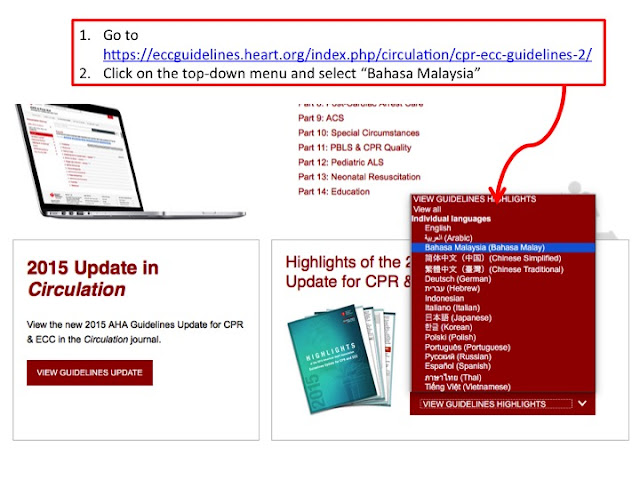
https://eccguidelines.heart.org/index.php/circulation/cpr-ecc-guidelines-2/ 
 

Wednesday, November 10, 2010

2010 AHA Guidelines on ECC and CPR

The American Heart Association (AHA) has recently updated the CPR and ECC Guidelines. You can access the full text pdf files of "AHA CPR and ECC Guidelines 2010" articles published in 18 October 2010 issue of Circulation by clicking here.

The most obvious and sensational change would probably be the change from the A-B-C to the C-A-B sequence of basic life support. In a way, I am not at all surprise of this change given the importance of chest compression ever since the last guidelines published in 2005. Numerous studies in recent years have shown the importance of chest compression, particularly for adult, non-traumatic, sudden onset of cardiac arrest, where the most probable etiology in most such cases would be myocardial infarction and its related arrhythmic sequelae of ventricular fibrillation, ventricular tachycardia, etc etc. In fact, over the last few years, we have seen a tremendous emphasis on chest compression so much so that AHA issued a scientific statement on Hands-Only CPR back in April 2008. At the same time, there is a de-emphasis on ventilation. Too much ventilation has the disadvantage of causing too much interruptions and impediment in our attempts in building up a good coronary perfusion pressure during chest compressions. Too much ventilation causes gastric distention as well, and increases risk of aspiration, reducing effectiveness of chest compression by splinting of diaphragm, In fact, too much ventilation is not necessary as the partial pressure of oxygen in the stagnated blood would have been enough to meet the minimal cellular metabolic demand in a cardiac arrest victim, especially during the first few minutes of arrest.


To me, the five major changes in Guidelines 2010 are:

1. The change from A-B-C sequence to C-A-B
- Beside minimizing delay, the C-A-B sequence also has the advantage over A-B-C because in A-B-C sequence, we are starting CPR with the steps which would be considered most repulsive for the public to initiate CPR (steps A and B). Thus, by using C-A-B sequence, we are encouraging public members to participate in CPR, enabling community empowerment and participation in this vital partnership of resuscitation.

Although no published human or animal evidence demonstrates that starting CPR with 30 compressions rather than 2 ventilations leads to improved outcome, chest compressions provide vital blood flow to the heart and brain, and studies of out-of-hospital adult cardiac arrest showed that survival was higher when bystanders made some attempt rather than no attempt to provide CPR.

2. Look, listen, feel is no longer recommended.
- “Look, listen, and feel for breathing” has been removed from the sequence for assessment of breathing after opening the airway. The healthcare provider briefly checks for breathing when checking responsiveness to detect signs of cardiac arrest. After delivery of 30 compressions, the lone rescuer opens the victim’s airway and delivers 2 breaths.

3. Atropine in cardiac arrest is out
Atropine is not recommended for routine use in the management of PEA/asystole and has been removed from the ACLS Cardiac Arrest Algorithm

4. Adenosine is in.
Adenosine is recommended in the initial diagnosis and treatment of stable, undifferentiated regular, monomorphic WCT

Note: adenosine should not be used for irregular WCTs because it may cause degeneration of the rhythm to VF.

5. Capnograph is in.
Capnography waveform can be used to check whether endotracheal intubation is successful or not, and secondly, it is used to monitor effectiveness of chest compression including achieving ROSC.

Other changes include:
Cricoid pressure
Cricoid pressure applied routinely is out.
Although it can prevent gastric aspiration, cricoid pressure may impede ventilation and interfere with placement of a supraglottic airway or intubation.

If cricoid pressure is used in special circumstances during cardiac arrest, the pressure should be adjusted, relaxed, or released if it impedes ventilation or advanced airway placement.

De-emphasis on pulse check
This guidelines minimizes the importance of pulse checks by healthcare providers. This is because detection of a pulse can be difficult, and even highly trained healthcare providers often incorrectly assess the presence or absence of a pulse when blood pressure is abnormally low or absent. Anyhow, chest compressions delivered to patients subsequently found not to be in cardiac arrest rarely lead to significant injury

Friday, July 02, 2010

Managing Cardiovascular Emergencies In A Malaysian Hospital - Challenges and Issues

This is the talk I gave during ICEM 2010 under the International Experience of Cardiology Track. In this presentation, I highlighted some of the challenges I see within the Malaysian setting, I focus mainly on prehospital and A&E setting. Issues that are conventionally under the care of the cardiologists are not discussed.

Creative Commons License
Managing Cardiovascular Emergencies In A Malaysian Hospital - Challenges and Issues by Dr. Chew Keng Sheng is licensed under a Creative Commons Attribution-NonCommercial-NoDerivs 3.0 Unported License.

COPYRIGHT NOTICE

PLEASE NOTE: All contents in this blog are copyrighted materials, unless otherwise stated. Even if you encounter materials in this page without a copyright notice, it does not mean that it is not copyrighted (Click here to read TEN BIG myths on copyright explained). This is especially so as most nations are signatories of the Berne Convention on international copyright law (World Intellectual Property Organization). Nevertheless, I have licensed almost all the materials contained here under Creative Commons licenses strictly for educational, non-commercial purposes only. Kindly email me at cksheng74@yahoo.com should you want to use any of the materials for commercial purposes. Thank you.