Showing posts with label snake bites. Show all posts

Saturday, March 18, 2023

AI and Snake Envenomation: A Game-Changer for Medical Treatment and Conservation


Photo by Pixabay: https://www.pexels.com/photo/blue-bright-lights-373543/

 Photo from pexels.com

Artificial intelligence (AI) is revolutionizing various industries, including healthcare. The use of AI capabilities, such as natural-language generation, computer vision, and robotic process automation, is growing exponentially. 

In a recent McKinsey report for example, it has been shown that organizations are increasingly making use of AI capabilities, with the average number of AI technologies used expected to double from 1.9 in 2018 to 3.8 in 2022

This growth is reflective of the widespread use of AI in fields like natural language generation and computer vision. Natural-language text understanding has advanced rapidly, moving from a mid-tier position in 2018 to ranking just behind computer vision in 2022, while robotic process automation and computer vision have consistently been the most widely adopted among these various capabilities.

In the field of herpetology and global health, AI can play a vital role in identifying snake species, which could have a significant impact on snakebite victims and conservation efforts.

AI in Snake Identification

Molecular methods such as the use of immunoassays for identifying snakes has its limitations, especially in resource-poor areas. Identification of snake species based on pattern recognition, on the other hand, although it is essential for medical professionals to do so in order to provide appropriate care, can be challenging. This gap can be closed with the help of AI models built on top of computer vision methods. While there are already AI models that can recognise common birds, fish, and butterflies, few have attempted to do the same for snakes, and those that have have focused on narrow taxonomic or geographical niches.

A recent study by Bolon et al. (2022) developed an AI model to identify snakes worldwide. The model achieved an impressive macro-averaged F1 score of 92.2% and demonstrated accurate classification of venomous and non-venomous lookalike species from Southeast Asia and sub-Saharan Africa. This technology could support snakebite victims, healthcare providers, zoologists, conservationists, and nature lovers across the globe.

F1 score is a metric used to evaluate the performance of classification models, particularly in situations where there is an imbalance in the number of samples between different classes. It is a combination of two other metrics: precision and recall. 

Precision basically means: of all the positive predictions I made, how many of them are truly positive? 

Precision = Number of True Positives (TP) divided by the Total Number of True Positives (TP) and False Positives (FP)  

Whereas recall means: of all the actual positive examples out there, how many of them did I correctly predict to be positive?

Recall = Number of True Positives (TP) divided by the Total Number of True Positives (TP) and False Negatives (FN).

The F1 score balances both precision and recall by taking their harmonic mean, providing a single value that represents the model's performance. The F1 score ranges from 0 to 1, where 1 indicates perfect precision and recall, and 0 means the model fails to make any correct predictions. 

Limitations of AI Models
 
Generative AI models may sometimes produce incorrect or biased information, posing risks in their application. The Bolon et al. (2022) study acknowledged limitations, such as the under-representation of snake species in some regions, the evaluation of model performance with easy-to-identify photos, and the need for further research in comparing lookalike species.

Addressing AI Bias

Human, systemic, and computational biases can affect AI models, impacting their usefulness and trustworthiness. Organizational leaders need to ensure AI systems improve human decision-making and reduce bias. Two imperatives for action include responsibly using AI to improve traditional human decision-making (this is where the human brains are still very much relevant) and the need of accelerating progress in addressing biases in AI.

Researchers also need to work on various techniques to ensure AI systems meet fairness definitions. One promising technique is counterfactual fairness, which guarantees that a model's decisions remain the same in a counterfactual world where sensitive attributes are changed.

Conclusion

AI has the potential to transform the medical and conservation fields, particularly in snake envenomation. The AI model developed by Bolon et al. (2022) represents a significant step forward in snake identification, ultimately benefiting snakebite victims, healthcare providers, and conservationists. However, addressing the limitations and biases in AI models remains a critical concern to fully harness the power of AI in these fields.

References

  • Bolon, I., Durso, A. M., Botero Mesa, S., Tollefson, S., Omori, R., Zurell, D., & Alcoba, G. (2022). An artificial intelligence model to identify snakes from across the world: Opportunities and challenges for global health and herpetology. PLOS Neglected Tropical Diseases, 16(2), e0010647. https://doi.org/10.1371/journal.pntd.0010647
  • Leong, K. (2022). Micro, macro & weighted averages of F1-score clearly explained. Towards Data Science. Retrieved from https://towardsdatascience.com/micro-macro-weighted-averages-of-f1-score-clearly-explained-b603420b292f
  • Manyika, J., Silberg, J., & Presten, M. (2019). What do we do about the biases in AI? Harvard Business Review. Retrieved from https://hbr.org/2019/10/what-do-we-do-about-the-biases-in-ai
  • McKinsey & Company. (2022). The state of AI in 2022 and a half-decade in review. https://www.mckinsey.com/capabilities/quantumblack/our-insights/the-state-of-ai-in-2022-and-a-half-decade-in-review#/
  • McKinsey & Company. (n.d.). What is generative AI? https://www.mckinsey.com/featured-insights/mckinsey-explainers/what-is-generative-ai#
  • National Institute of Standards and Technology. (2022). There's more to AI bias than biased data: NIST report highlights. https://www.nist.gov/news-events/news/2022/03/theres-more-ai-bias-biased-data-nist-report-highlights




Monday, December 14, 2009

TEN Interesting Facts About Venomous Snakes in Malaysia That You May Not Know

While researching for facts for a First aid book manuscript by my colleauges and I, I have stumbled upon many interesting facts about venomous snake bites in Malaysia. I have compiled them and placed them in this blog post. Free reference resources that I have used are found at the end of this blog post.

1. Most snakes in Malaysia are harmless to human
17 out of the 105 strictly land snakes are venomous
Even bites of venomous snakes are not life threatening in humans unless sufficient venom is injected at the time of bite. In fact, most are dry bites. The problem, however, is the accurate identification by the witnesses. Because we are not sure whether the snake is venomous or not, coupled with the fact that there is no simple physical features criteria to differentiate venomous from non-venomous snakes, the victim should be treated with vigilant medical care for the benefit of doubt.

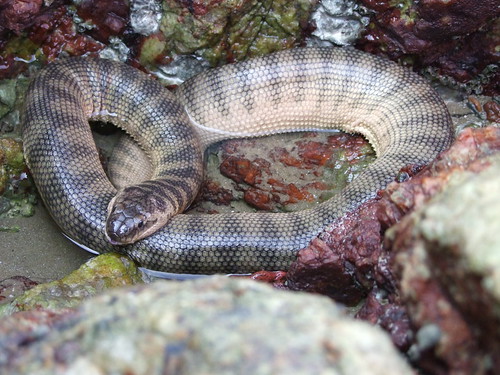
2. All sea snakes in Malaysia are venomous, they are powerful and dangerous to human.
All 14 species of fresh water snakes are harmless but all 22 species of sea snakes are venomous

Most sea snakes live along shallow coastal water and therefore, fishermen is the group of people most at risk to be bitten by sea snake.
Enhydrina schistosa

Enhydrina schistosa is the most common and dangerous sea snakes along the coast and in river mouths of Peninsular Malaysia. This may surprise some people, but the venom of this snake is rated four to eight times as toxic as cobra venom.

3. Unfortunately, sea snake bites have little or no pain, and no edema (or only with a mild local reaction) at the site of bite. (On the contrary, fish stings are painful).

4. According to many studies, most (about 2/3rd) of the snake bites in Malaysia are due to the Malaysian pit viper bites.
And about 75% of these cases are confined to the northern states of Perlis, Kedah and Penang.
Snake bites are twice as common in males as in females, and it commonly affects the age group of 10 - 19 years old.

5. A peculiar characteristic of the Malayan pit viper is that it will not easily move away, but rather will stay on at the same spot despite several hours after the attack, and therefore, it can be easily found!!

This earn the Malayan pit viper the Malay name "ULAR KAPAK BODOH" (translated as "the dumb pit viper") [click here to read the article "The Medically Important Poisonous Snakes In Malaysia" by Prof Tan Nget Hong]

Triangular head of the Malayan pit viper


6.
Contrary to what many people believe, the King Cobra is actually not an aggressive snake. In fact, it keeps out of people's way.
It only attack when provoked, or accidentally stepped on. And
if cornered, the king cobra can be extremely dangerous because of the large amount of venom it is capable of delivering in a bite.

7. On the other hand, the Malayan pit viper, although a "dumb" snake, it is a bad tempered snake, quick to strike if disturbed.

8. One should not assume that bites from the young, small or baby snakes are less harmful.
Quite the contrary! According to the WHO management guidelines for snake bites in South East Asia region (see link below for free download of this excellent manual), although large snakes tend to inject more venom than smaller specimens of the same species, the venom of smaller, younger vipers may be richer in some dangerous components, such as those affecting haemostasis. Therefore, bites by small snakes should not be ignored or dismissed. They should be taken just as seriously as bites by large snakes of the same species.

In fact, there is a legend that says that the young snakes have not yet learned how to control the amount of venom they inject. They are therefore more dangerous than adult snakes, which will restrict the amount of venom that accompanies a bite. It’s repeated so often that it’s become a sort of mantra among laypeople and biologists alike!

Whether this legend is true or not is beyond the scope of this medically focused post as this is more of a herpetology question (for a more extensive discussion of this questionable nature of baby snake, click here for this blog post). But suffice to summarily say here (to borrow the argument from that blog post), that for this legend to be true, the follow four assumptions must also be answered:

  1. this means that snakes are able to control the amount of venom they inject?
  2. this means that there is some disadvantage to a snake when it injects all of its venom in every bite? (otherwise why not inject all of their venom all of the time?)
  3. and as a result, as the snake mature, the snake learns of the disadvantages of injecting all venoms and therefore, change its behavior?
  4. a full envenomation from a young snake maybe more dangerous than a partial envenomation from an adult snake?


9. There is no simple rule to differentiate a venomous snake from a non-venomous snake although certain features are notoriously seen in venomous snakes like a spreading hood in cobra, a triangular head and Loreal pits between the eyes and the nostril of a pit viper, the pair of sharp fangs as well as the more elliptical eyes as compared to the rounded eyes of non venomous snakes. Nevertheless, some harmless snakes have evolved to look almost identical to venomous ones.
The pair of fangs, spreading hood and elliptical eyes of a king cobra


The loreal pits colored red - an infrared sensor organ

10. Do not handle a dead snake as reflex envenomation by the decapitated head of the snake can still occurs up to several hours after its death!! In a website, it is quoted that reflex envenomation causes up to 3% of snake bites.

Free Resources:
1. FREE Download of "The Clinical Management of Snake Bites In The South East Asia Region" by the WHO. Click here.

2. FREE Download of "Ministry of Health Malaysia Clinical Protocol Management of Snake Bite". Click here.

3. Jamaiah I, Rohela M, Roshalina R et al. Prevalence of snake bites in Kangar District Hospital, Perlis, west Malaysia: a retrospective study (January 1999-December 2000). Southeast Asian J Trop Med Public Health 2004; 35 (4):962-5. Click here to download FREE pdf copy.

4. Jamaiah I, Rohela M, Ng TK et al. Retrospective prevalence of snakebites from Hospital Kuala Lumpur (HKL) (1999-2003). Southeast Asian J Trop Med Public Health 2006; 37 (1):200-5. Click here to download FREE pdf copy.

Free Web Resources
5. The Medically Important Poisonous Snakes of Malaysia by Prof Tan Nget Hong. Click here

6. The Management of Snakebites in Malaysia by Prof Tan Nget Hong. Click here.


Note:
All images in this blog post are linked, scaled images from the original sources. I do not own the copyright of any of them. They are linked here for non-commercial, educational purposes only. Clicking on the image will bring you back to the original source. If you are the copyright owner and want the image to be removed, please email me. Thanks.

COPYRIGHT NOTICE

PLEASE NOTE: All contents in this blog are copyrighted materials, unless otherwise stated. Even if you encounter materials in this page without a copyright notice, it does not mean that it is not copyrighted (Click here to read TEN BIG myths on copyright explained). This is especially so as most nations are signatories of the Berne Convention on international copyright law (World Intellectual Property Organization). Nevertheless, I have licensed almost all the materials contained here under Creative Commons licenses strictly for educational, non-commercial purposes only. Kindly email me at cksheng74@yahoo.com should you want to use any of the materials for commercial purposes. Thank you.